


This comprehensive study explores the spiritual journey of C.S. Lewis, tracing his trajectory from childhood faith to adolescent atheism, through the corridors of academic skepticism, and finally to a devout Christian faith.
Key Pillars of the Journey:
- The Catalyst of Grief: How personal loss (death of his mother) and global trauma (WWI) fueled a retreat into materialism.
- The Role of Intellectual Fellowship: The influence of J.R.R. Tolkien and the “Inklings” in bridging the gap between myth and truth.
- The Concept of “Joy”: The discovery of a longing for the transcendent that cannot be satisfied by earthly means.
- The “Great Knock”: The transition from theoretical theism (believing in a God) to personal Christianity (believing in Christ).
- Literary Legacy: How his conversion birthed a new era of apologetics, blending academic rigor with imaginative storytelling.
Spiritual Awakening: Atheism to Christianity
C.S. Lewis, the celebrated British author and scholar, is renowned for his profound contributions to literature, philosophy, and Christian theology. His iconic works, such as The Chronicles of Narnia and Mere Christianity, have touched the hearts and minds of countless individuals, inspiring them to ponder the profound mysteries of faith. But what of the man behind these writings? What was the catalyst for his own spiritual awakening?
For now we see through a glass, darkly; but then face to face: now I know in part; but then shall I know even as also I am known.
Join me as we delve into the captivating narrative of C.S. Lewis’s journey from atheism to Christianity—a transformation that not only shaped his life but also left an indelible mark on the world. To understand Lewis is to understand the struggle of the modern mind: the tension between the cold requirements of logic and the warm, persistent longing for something more.
Academic Definition
apologetics
Apologetics is the religious discipline of defending a particular religious doctrine through systematic argumentation and reasoned apology. It is not an “apology” in the sense of saying sorry, but rather a formal defense (from the Greek ‘apologia’) of the faith.
The Intellectual Framework of the Conversion
Lewis did not arrive at faith through a sudden emotional whim. His path was a “triangulation” of three forces:
- Intellectual Rigor: The demand for evidence and logical consistency.
- Imaginative Resonance: The realization that “myths” often contain latent truths.
- Personal Experience: The “Surprise” of Joy—a specific emotional state of longing.
The Early Years: A Seed of Skepticism
Born in Belfast, Ireland, in 1898, Clive Staples Lewis—known as “Jack” to his inner circle—grew up in a home defined by a spiritual dichotomy. His mother, Flora, was a devout Anglican, providing a foundation of faith and piety. Conversely, his father, Albert, was an atheist, providing a foundation of critical thinking and skepticism.
The stability of this childhood was shattered by the untimely death of his mother. For the young Lewis, this was not merely a personal loss but a theological crisis. He began to question how a benevolent God could allow such suffering. This seed of doubt grew into a full-fledged rejection of the divine by age 15.
The Formative Influences on Early Lewis
| Factor | Influence | Outcome |
|---|---|---|
| Maternal Influence | Devout Anglicanism | Early exposure to scripture and liturgy |
| Paternal Influence | Rationalist Atheism | Appreciation for logic and skepticism |
| Personal Trauma | Death of Mother | Crisis of faith; questioning God’s goodness |
| Global Event | World War I | Disillusionment with humanity and providence |
The horrors of World War I further entrenched his skepticism. Seeing the carnage of the trenches, Lewis viewed the world as a place of random brutality, devoid of a guiding, loving hand. He adopted a worldview of Materialism—the belief that nothing exists except matter and its movements.
Academic Definition
materialism (philosophical)
The philosophical position that the universe is composed entirely of physical matter. In this view, consciousness, soul, and deity are seen as illusions or biological accidents rather than supernatural realities.
The heart is deceitful above all things, and desperately wicked: who can know it?
The Influence of Friendship and Intellectual Rigor
Lewis’s journey back to Christianity began at Oxford University. While he was a brilliant academic, he was also a lonely one, until he encountered the “Inklings”—a literary circle that included the legendary J.R.R. Tolkien.
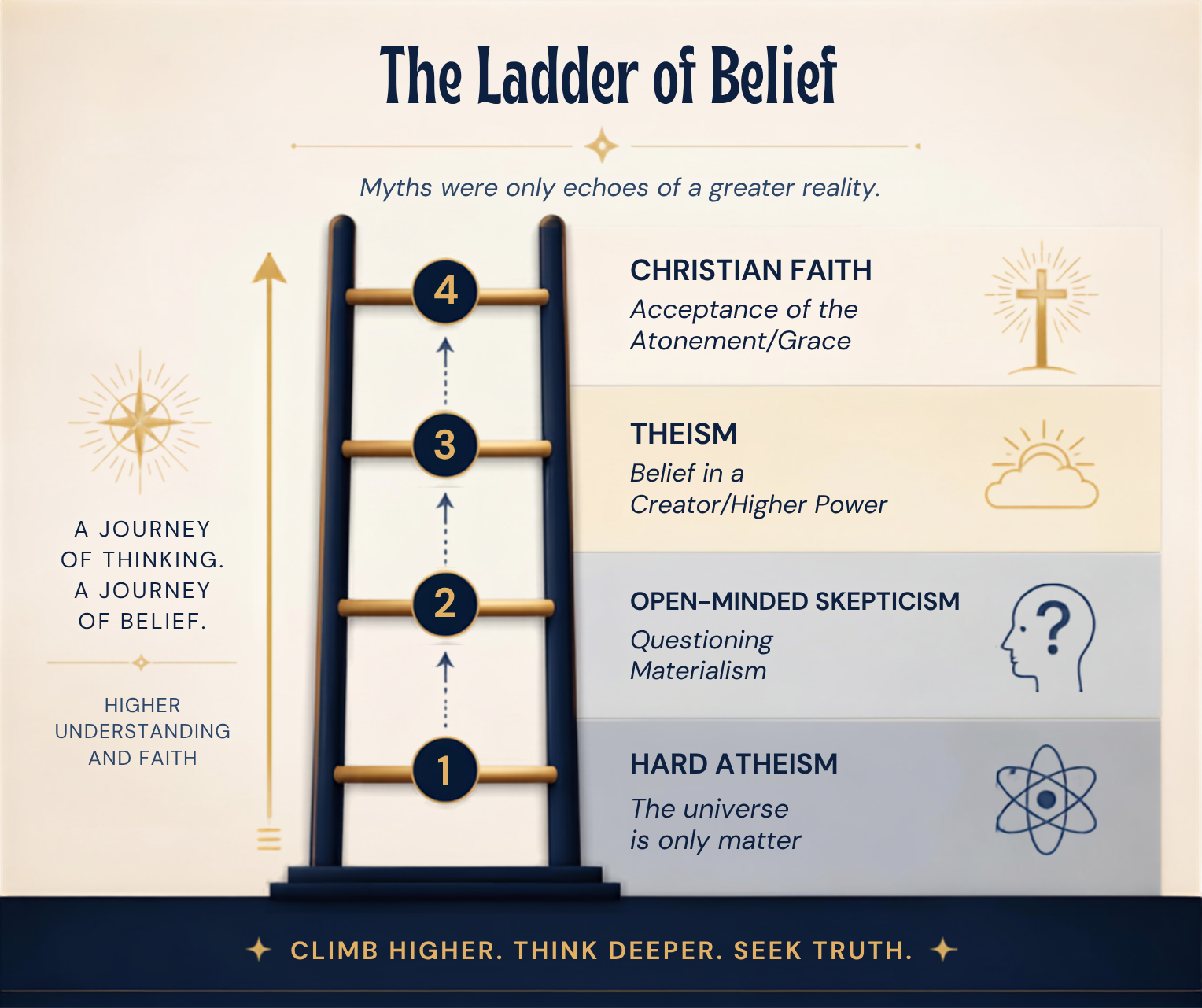
Tolkien’s role in Lewis’s life cannot be overstated. While Lewis approached religion as a problem to be solved with logic, Tolkien approached it as a story to be lived. Tolkien introduced Lewis to the concept of “True Myth.” He argued that the stories of the ancient world—the myths of gods and heroes—were not lies, but “splinters of the true light.” He suggested that the story of Christ was the “Myth become Fact.”
The Dynamic of the Inklings
The Inklings provided a “safe harbor” for intellectual exploration. In this circle, Lewis could be a skeptic without being mocked, and Tolkien could be a Catholic without being dismissed. This intellectual rigor meant that Lewis’s return to faith was not a “blind leap,” but a slow climb up a ladder of evidence.
Comparison of Worldviews (Lewis’s Transition)
| Concept | Atheist Lewis | Theist Lewis | Christian Lewis |
|---|---|---|---|
| The Universe | Random accident | Designed by a Mind | Created by a Loving Father |
| Humanity | Biological machines | Beings with a purpose | Fallen beings needing grace |
| Morality | Social convention | Objective moral law | The character of God |
| Myth | Useful lies | Echoes of truth | Pre-figurations of Christ |
In 1929, a pivotal night of discussion with Tolkien and Hugo Dyson occurred. Lewis described a sensation of “Joy”—not the joy of happiness, but a piercing longing for a world he had never visited but somehow remembered. He termed this “Surprised by Joy.”
The Intellectual Foundations: From Atheism to Theism
Before Lewis accepted Christ, he had to accept God. This was a two-step process: first, moving from Atheism to Theism (belief in a generic God), and then from Theism to Christianity (belief in the specific God of the Bible).
The Influence of G.K. Chesterton
Lewis was deeply moved by G.K. Chesterton, particularly The Everlasting Man. Chesterton’s unique style—using paradox to reveal truth—showed Lewis that faith was not the absence of reason, but the fulfillment of it. Chesterton argued that the “modern” man was actually the most narrow-minded, as he ignored the vast history of human spiritual experience.
The Critique of Bertrand Russell
For a time, Lewis leaned on the arguments of Bertrand Russell, a titan of 20th-century atheism. Russell provided a polished, intellectual framework for disbelief. However, Lewis found a void in Russell’s logic: if the universe is purely material, why does the human mind possess a desire for something “transcendent” that the material world cannot provide
Academic Definition
transcendence
The quality of being beyond the range of normal physical human experience. In theology, it refers to the existence of a deity that is beyond the limitations of the physical universe.
Search the scriptures; for in them ye think ye have eternal life: and they are they which testify of me.
The Pivotal Moment: The Abolition of Man
One of the most transformative moments in Lewis’s spiritual life occurred during a motorcycle ride with J.R.R. Tolkien. This was not a formal debate, but a conversation between friends moving through the English countryside.
Tolkien presented the idea that myths are “splinters of the true light.” He argued that God uses the imagination as a conduit for truth. For Lewis, who loved literature and poetry, this was the “key” that unlocked the door. If myths were echoes of a greater reality, then the “Great Myth” (the Gospel) might actually be true.
This realization led Lewis to write The Abolition of Man, where he argues for the existence of the “Tao”—a universal moral law that transcends human culture. He realized that if there is a moral law, there must be a Lawgiver.
The Road to Christianity: The Great Knock
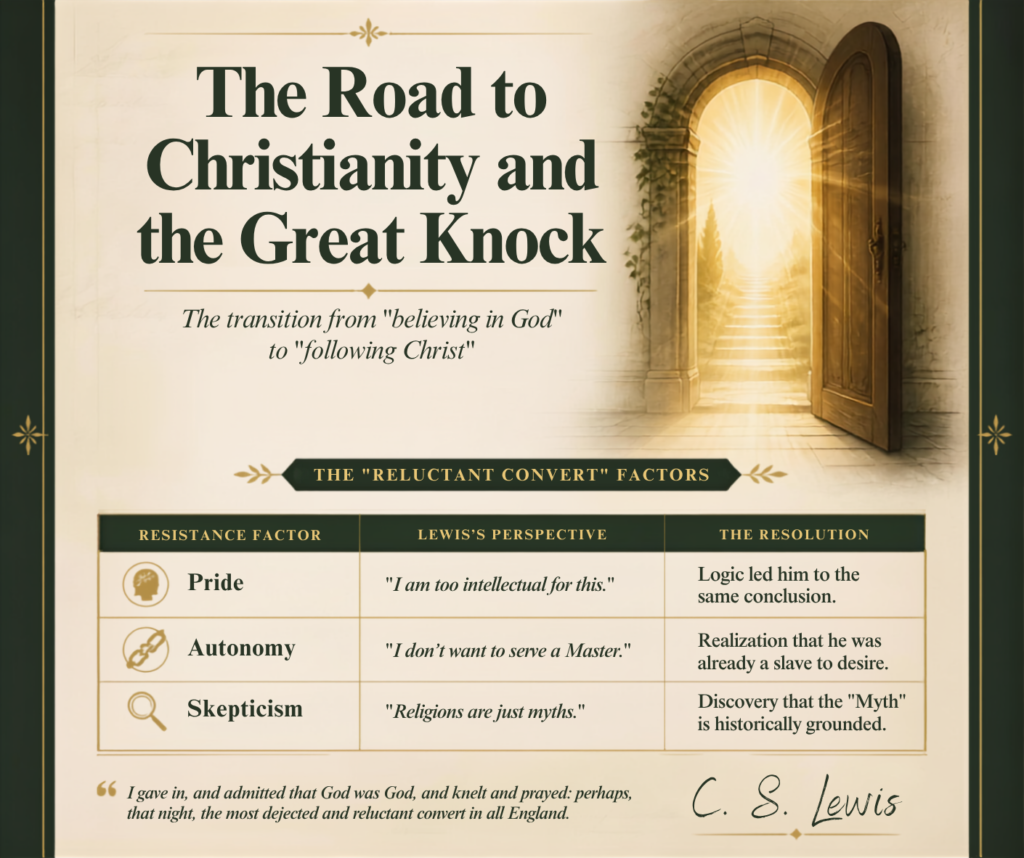
The transition from “believing in God” to “following Christ” is what Lewis called “The Great Knock.” In 1931, while riding a bus, he experienced a moment of total clarity. He described the sensation as the “door of the universe bursting open.”
He did not experience a mystical vision of angels; rather, he experienced the intellectual and spiritual surrender to the fact that God is real and that He is the rightful King of the universe.
The Nature of the Surrender
Lewis’s conversion is famous because it was reluctant. He did not want to be a Christian because it meant his autonomy was gone.
Humble yourselves therefore under the mighty hand of God, that he may exalt you in due time:
The Influence of George MacDonald
While Tolkien provided the intellectual bridge, George MacDonald provided the emotional heart. MacDonald was a 19th-century Scottish author whose fantasy works, like Phantastes, introduced Lewis to a different image of God.
Instead of a distant judge or a cold architect, MacDonald presented a God of overwhelming love and grace. This shifted Lewis’s perspective from a “legal” view of religion (following rules) to a “relational” view (knowing a Father). MacDonald’s influence is evident in Lewis’s later works, where the theme of “Divine Love” overrides the theme of “Divine Judgment.”
Academic Definition
grace (theological)
The unmerited favor of God, whereby sinners are regenerated by his Spirit and reconciled to God, not because of their own merit, but by the sacrifice of Christ.
The Chronicles of a Transformed Heart
C.S. Lewis’s conversion was not a straight line but a winding path of doubt, discovery, and eventual surrender. It was a symphony played by many instruments: the logic of Chesterton, the friendship of Tolkien, the imagination of MacDonald, and the silence of his own longing.
His legacy is a testament to the fact that faith and reason are not enemies. Lewis showed the world that one could be a scholar, a critic, and a skeptic, and still find their home in the ancient truths of the Gospel. He transitioned from being a man who analyzed the “idea” of God to a man who served the “Person” of Christ.
For all have sinned, and come short of the glory of God;
Continue Your Journey: The Pilgrim’s Regress
To truly understand the “mapping” of Lewis’s mind, one must look at his allegorical novel, The Pilgrim’s Regress (1933). This work serves as a spiritual autobiography in fictional form.
Plot Summary and Analysis
The story follows a man named John who lives in the “Shadowlands.” He is plagued by a sense of dissatisfaction and a longing for the “Isle of the Blessed.” His journey is a critique of the various “isms” of the 20th century:
- Materialism: The attempt to find peace in physical pleasure.
- Idealism: The attempt to find peace in abstract thought.
- Mysticism: The attempt to find peace in a vague “oneness” with the universe.
Ultimately, John discovers that the Isle of the Blessed is not a place he can find on a map, but a destination reached through the guidance of a Shepherd—a Christ-figure. This mirrors Lewis’s own realization that neither philosophy nor poetry could satisfy the “Joy” within him; only the Shepherd could.

The Pilgrim’s Regress 1.12 MB 15 downloads
“The Pilgrim’s Regress” is an allegorical novel by C.S. Lewis, originally published…Allegorical Mapping in “The Pilgrim’s Regress”
| Character/Place | Symbolic Meaning | Lewis’s Real-Life Parallel |
|---|---|---|
| The Shadowlands | A world of illusion/half-truths | His years as an atheist |
| The Quest for the Isle | The human search for meaning | His academic pursuit of Truth |
| The Various ‘Isms’ | Dead-end philosophies | His study of Russell and James |
| The Shepherd | Jesus Christ | His final conversion in 1931 |
Bibliography and Sources
Primary Source Authors:
- Lewis, C.S. – Surprised by Joy (Autobiography)
- Lewis, C.S. – Mere Christianity (Theological Framework)
- Lewis, C.S. – The Abolition of Man (Philosophical Treatise)
- Lewis, C.S. – The Pilgrim’s Regress (Allegorical Novel)
Contributing Influences (Referenced in Text):
- Tolkien, J.R.R. – Letters and personal correspondence regarding “True Myth.”
- Chesterton, G.K. – The Everlasting Man.
- MacDonald, George – Phantastes and The Great Divorce.
- Russell, Bertrand – Various philosophical essays on Logic and Atheism.
- James, William – The Will to Believe.
Extended Research Sources:
- The Holy Bible, King James Version (KJV).
- Stanford Encyclopedia of Philosophy (Entry on Materialism and Theism).
- The C.S. Lewis Institute (Biographical data and timeline of conversion).
- Wikipedia: C.S. Lewis / The Inklings (General biographical data and academic tenure).
- C.S. Lewis, “Surprised by Joy: The Shape of My Early Life”
- Alister McGrath, “C.S. Lewis: A Life”
- Walter Hooper (ed.), “The Collected Letters of C.S. Lewis”
- Humphrey Carpenter, “The Inklings: C.S. Lewis, J.R.R. Tolkien, Charles Williams, and Their Friends”
- George M. Marsden, “C.S. Lewis’s Mere Christianity: A Biographical and Theological Introduction”